
Finding Richmond Resident Records
Richmond stands alone as an independent city. It does not sit inside any Richmond County. That fact shapes every records search. Parcels within City limits belong to the City Assessor. Deeds are handled by the Richmond Circuit Court Clerk. Each name found in these records carries its own role and date. A person may appear as an owner, grantor, heir, or party to a case. None of that proves who lives at the address now.
Start from whatever is already known. An address is easiest to trace through parcel and map tools. A full name paired with a rough year tends to work better in the Richmond Room. City directories, newspaper archives, and related indexes also reward that approach. A court file number, meanwhile, belongs with the court system itself. The residents directory trail across Richmond is really a web of connected sources. It is not one master roster.
- For an address, find the parcel and confirm that it is in Richmond City rather than a nearby locality with a Richmond postal label.
- Keep the property address, parcel identifier, map result, and search date together before looking for a recorded instrument.
- For an older household, compare a dated directory entry with a census, deed, tax, newspaper, or cemetery source from the same period.
- For a court matter, confirm the locality, case number, event date, and disposition through the appropriate official route.
- When a portal lacks the needed item, ask the named custodian for a narrow record and date range, not a broad personal file.
Note: Record a source role, event date, and retrieval date so a deed party or historic directory listing is not treated as a current resident.
Richmond Resident Record Offices
Three City offices answer most questions. The Assessor ties a place to its parcel. The Circuit Clerk keeps land, probate, and court-related records. The Office of Elections handles registration, though its status tool serves a voter checking a personal record, and its list products carry strict statutory controls. Richmond has no county recorder or county assessor standing in for these offices.
Richmond Circuit Court Clerk
John Marshall Courts Building
400 N 9th Street
Richmond, VA 23219
804-646-6505
Richmond Office of Elections
2134 W Laburnum Avenue
Richmond, VA 23227
804-646-5950
Does a portal hide an image or an older index? The Circuit Clerk’s record room is the fallback. Assessor and planning staff can sort out parcel and map routing. Elections staff can explain registration steps and authorized-list procedures. A quick phone call can confirm a portal change, an eligibility rule, or a copy route. It can save a trip. That matters before you travel or mail a written request.
Richmond Parcel Search Fields
The City upgraded its property system. The legacy route now redirects to a replacement. Even so, the old search form remains a useful guide. It shows what a parcel search can hold. Begin with an address or a parcel identifier. The former owner-name option was removed in 2017 for safety reasons. An address or parcel number is now the practical starting point for a City lookup.
| Field group | Richmond detail | Research use |
|---|---|---|
| Parcel ID | Partial text accepted in the legacy form, with autosuggest after eight digits | Stable key for map and deed research |
| Property address | Building number, optional range, direction, street name, and street type | Find a mapped property and normalize an address |
| Property ZIP | Legacy other-information filter | Narrow a search, never prove City jurisdiction |
| Assessment and transfer | Land, use, class, value, improvement, transfer, and year-built filters | Time-bound property context, not occupancy proof |
The legacy assessor search form still shows the old address, parcel, transfer, improvement, and ZIP filters. Treat it as a field inventory rather than a promise that the replacement returns the same results.
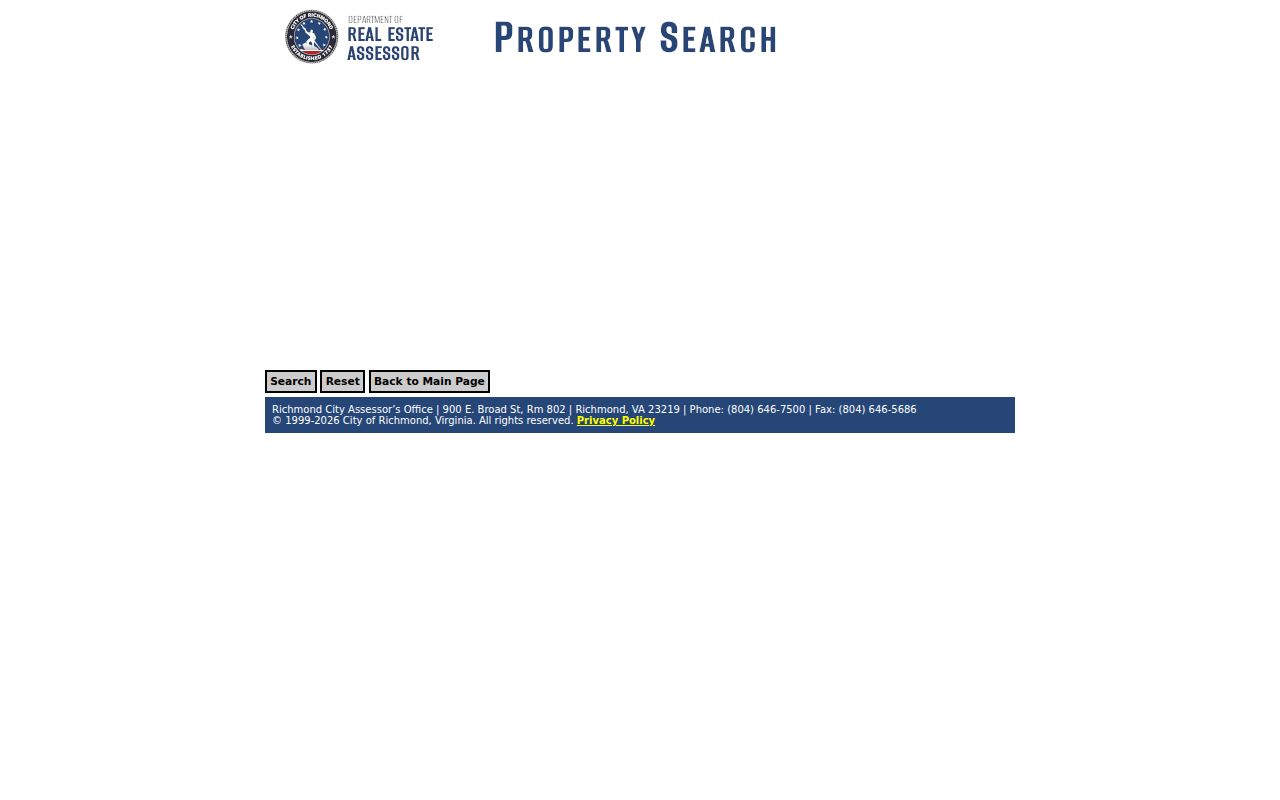
The saved address and parcel fields still help. They let you compare a legacy result with the City’s current official routing.
Use the Richmond interactive mapping tools to search an address or intersection. Then click inside a parcel. A click on a right-of-way or outside any parcel may return nothing. The mapper’s zoning, historic-district, and planning layers describe a place well, but they are not a residents directory.
- Parcel
- A mapped property unit with an identifier used by assessment and land-record systems.
- Primary address
- The one assessment address the City maintains, which can differ from utility or emergency-address data.
- Grantor and grantee
- The party transferring an interest and the party receiving it in a recorded instrument.
- Record role
- The reason a name appears, such as owner, heir, witness, or party, rather than a claim of residence.
Richmond Voter Record Boundaries
Virginia’s Citizen Portal is a personal route. It asks the voter for identifying details, locality, and a certification before it returns registration information. It is not a public name search. The City election office supports registration and election administration, but a voter result should never be republished as a resident list.
The Virginia voter-status screen is the official self-service route. Never enter a person’s sensitive values in a public worksheet or screenshot.
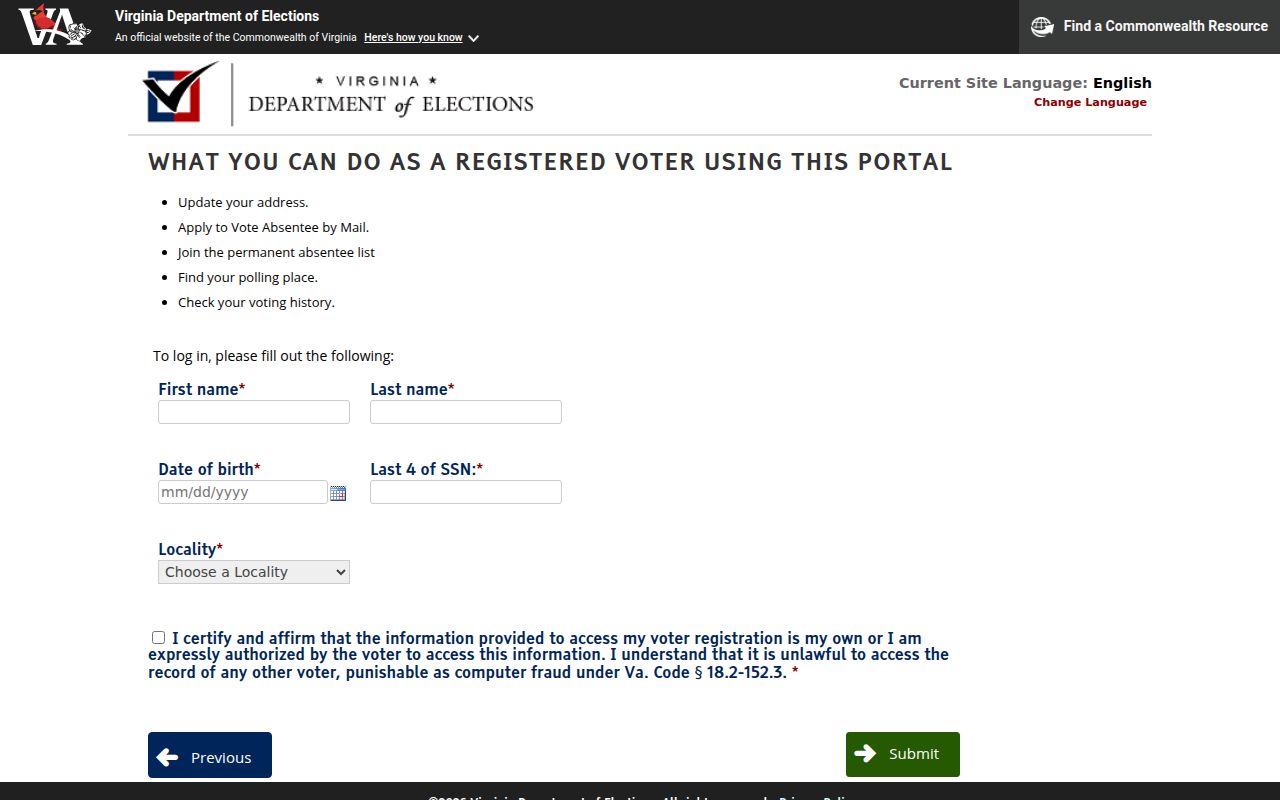
The certification and identifying fields explain the form’s single purpose: a voter’s own self-check.
Registered-voter and voting-history products fall under Va. Code §24.2-405 and related provisions. Authorized requesters must follow the official process and its stated purpose categories. The request form offers locality and district filters. Yet it is not an open feed for a searchable directory.
The official Virginia voter-list form documents the requester and product controls.
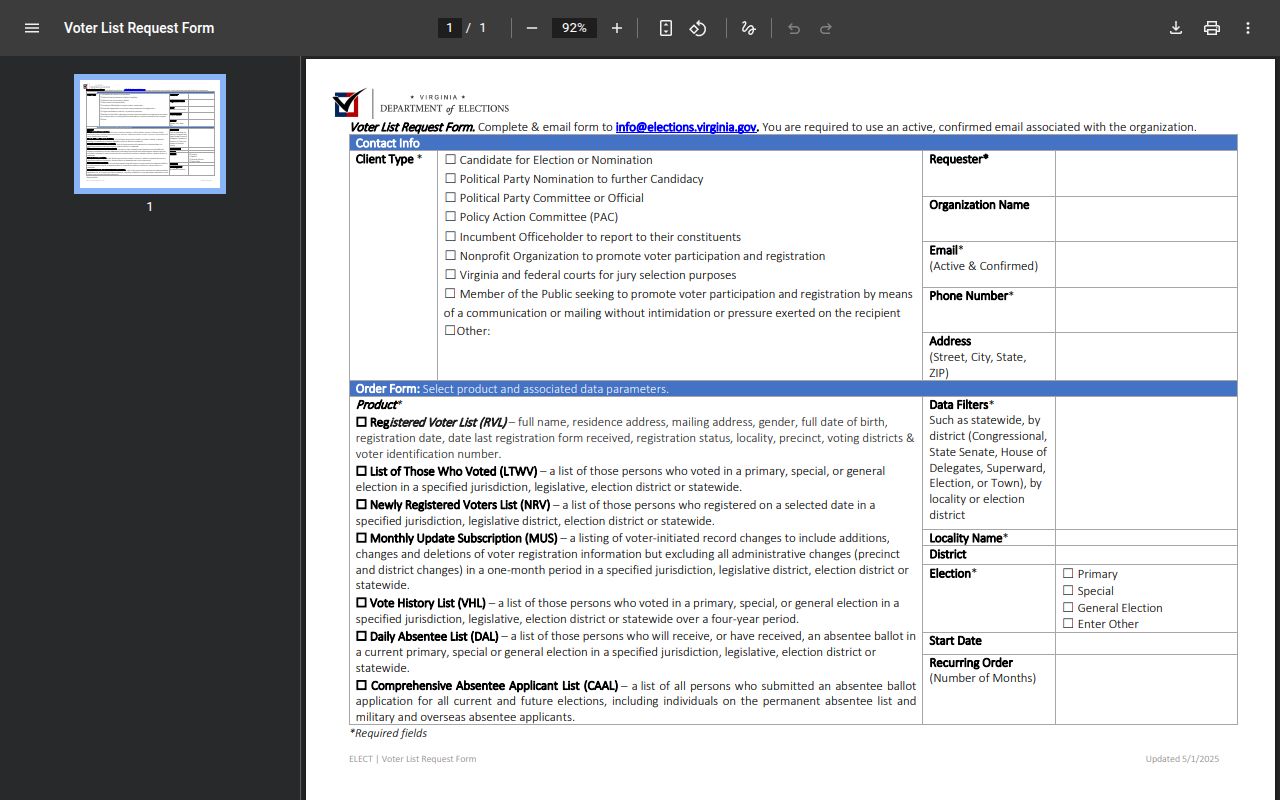
Note: Its authorization and responsibility terms are a reminder to use voter material only through the statutory route.
Richmond Deed and Court Trails
The Richmond Circuit Court Clerk keeps the land records for the city. These include deeds, deeds of trust, plats, wills, estates, marriage licenses, and other recorded instruments. Digitized land records reach back to 1782. Division I covers the area north of the James. Division II covers the south side, including old Manchester, back to 1874. A deed records a property transaction. It does not prove that every named party lived at the address.
Deed Search and the Clerk’s secure remote-access route describe the online path. Subscriber access, in-person research, and written requests are separate channels. A written request should name the instrument, the parties, and the date range. It should also include the book and page or instrument number, and whether a certified copy is needed. The Clerk’s research materials list copies at $0.50 per page plus $2 for certification. Payment is due in advance.
The statewide Online Case Information System offers Name, Case Number, and Hearing Date modes. It returns selected court and case data. A local clerk supplies the complete file when permitted. OCIS does not cover every record category. It hides protected material in some J&DR matters.
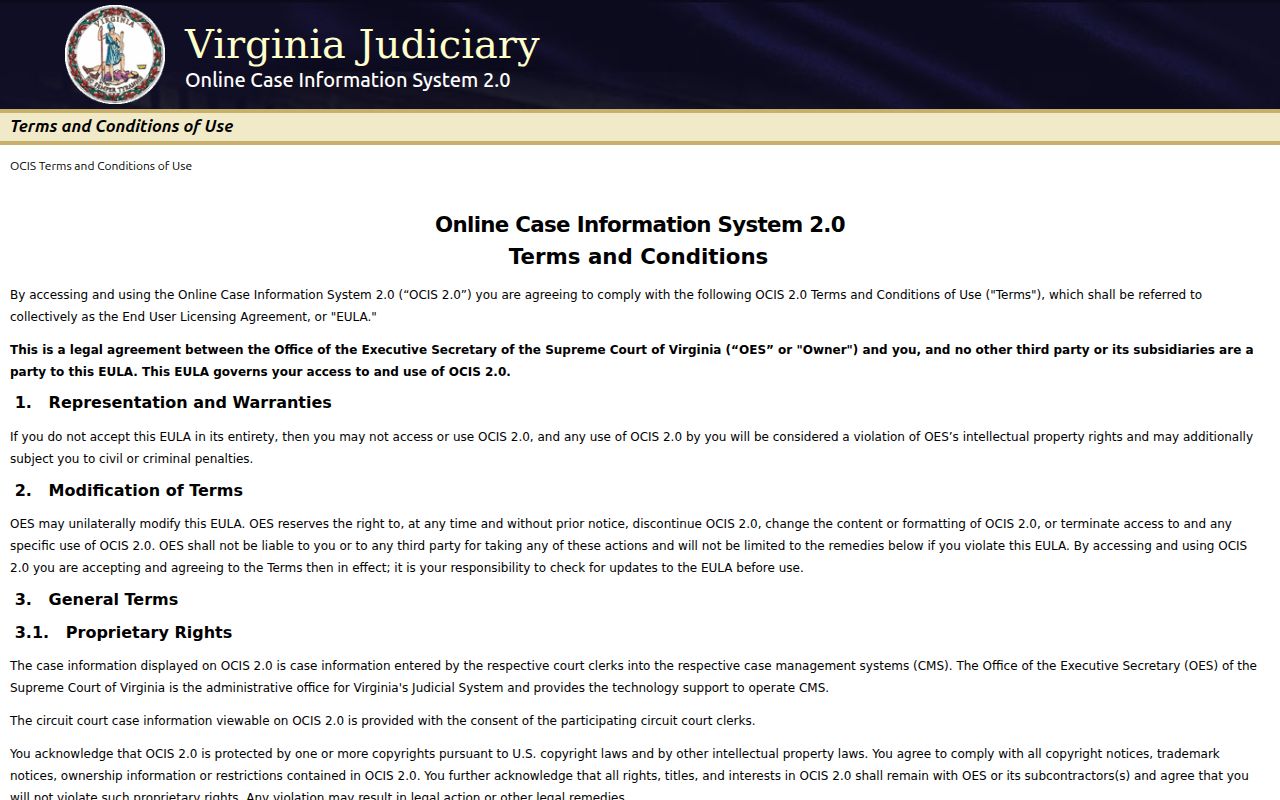
The acknowledgement screen comes first for a reason. Before any search fields appear, it spells out the scope and use limits that govern this official Richmond case search.
Richmond FOIA Record Requests
Virginia's Freedom of Information Act opens a path when a City record sits outside the normal portal. Under Va. Code §2.2-3704, a public body usually answers within five working days. The reply may produce records, cite a basis for withholding, say it does not hold them, or claim more time. Name a defined record. Give a date range. Ask for electronic delivery where it exists. Richmond's FOIA page accepts requests online, by mail, fax, email, in person, and by phone. A new request platform was announced in May 2026. Richmond Police runs its own FOIA channel. Neither route replaces a department's specialized process, and exemptions or redactions can still apply to what comes back.
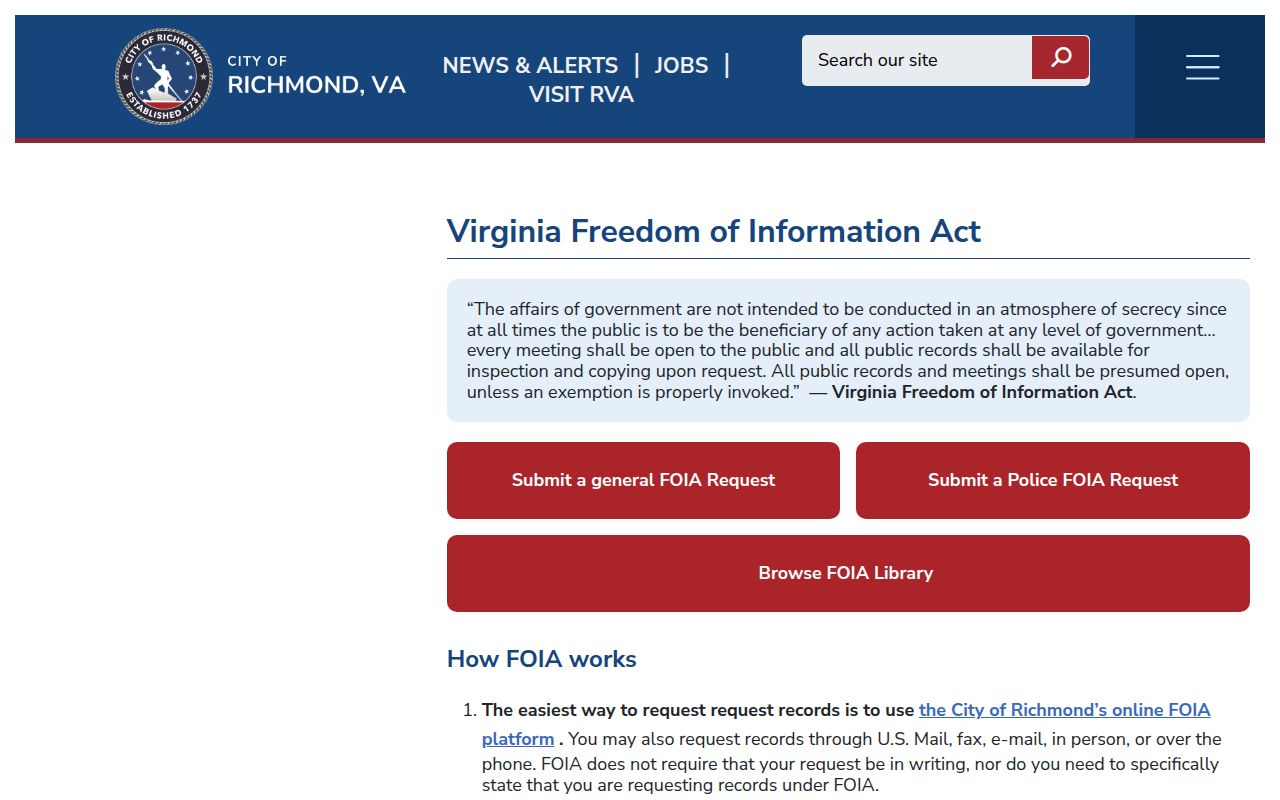
Once the right custodian is identified, the City entry point works well. It helps with tracking a narrow Richmond request. Keep it tight. The Richmond Police FOIA form shows why. It asks for the report or incident and a date range, not a fishing expedition. Check its fee and deposit notices on the current form before sending payment.
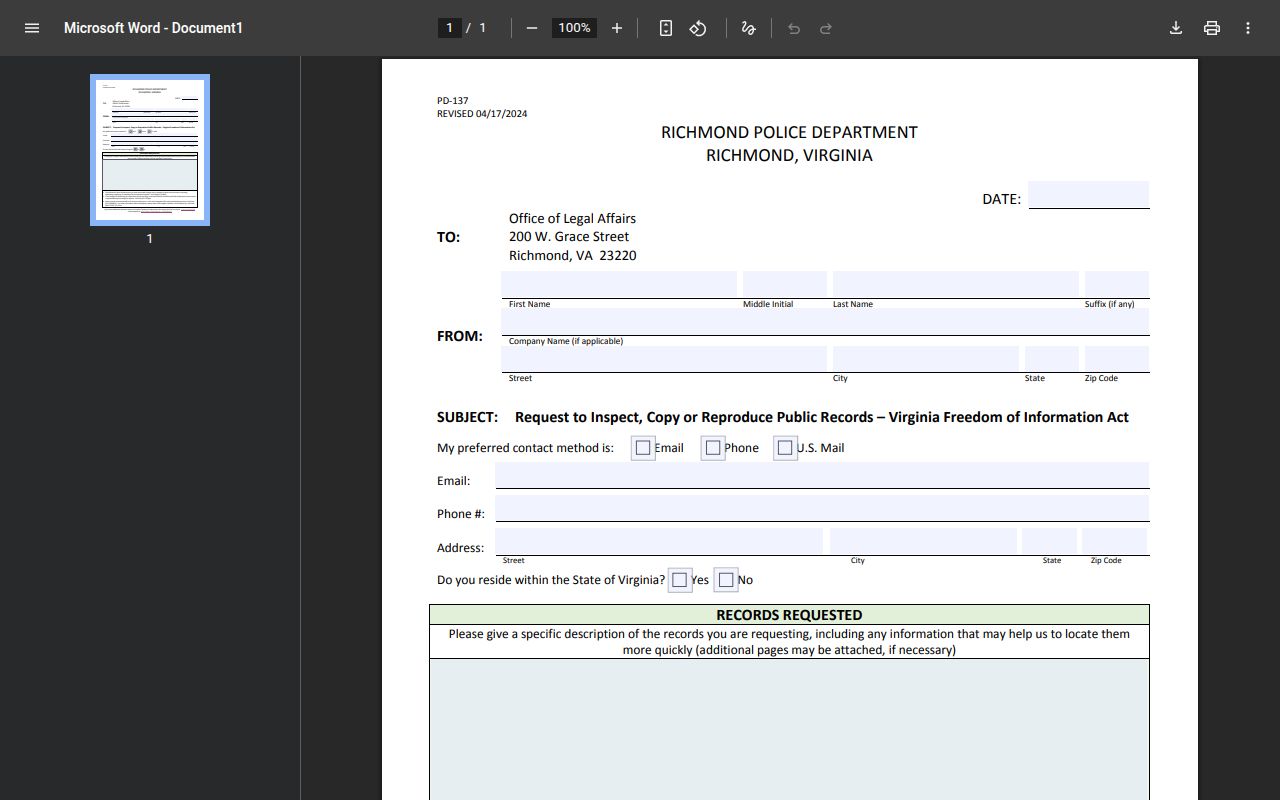
The form's specific fields do quiet work. They help a requester describe a record plainly, without stretching a public request into a broad personal-file search.
Current Richmond Directory Sources
Current sources answer narrow questions. The parcel tools supply property context. Court and deed indexes point to a filing or instrument. Permit, code, Council, cemetery, and civic records can tie a person or organization to a dated Richmond event. None of them is an all-purpose list of City residents. Each demands a source-specific read. That is why a Richmond residents directory built from these pieces stays a careful, one-question-at-a-time exercise.
| Source | What it can show | Custodian | Access boundary |
|---|---|---|---|
| Parcel and map record | Parcel, address, assessment context, map relationship | Richmond Assessor and Parcel Mapper | Public route; property evidence is not occupancy proof |
| Land index | Recorded parties, instrument, date, legal description | Richmond Circuit Court Clerk | Remote, counter, and written channels vary |
| Permit or code record | Project, address, status, dates, possible responsible party | Richmond PDR | Underlying files may require a request |
| Civic group inventory | Organization name, stated area, supplied contact | City of Richmond | Orientation only, no published member roll |
For one carefully bounded name-and-date question, the Richmond resident lookup route explains the method. It shows how to anchor a result to independent records instead of trusting a single plausible match.
Richmond License Record Checks
Business and license records can explain why a name surfaces in Richmond. Read them as organization or credential records, not household listings. Virginia SCC CIS searches business filings by entity name or ID. The Department of Professional and Occupational Regulation goes further. It searches regulated license records by name, license number, address or ZIP, board, and license type. The DPOR advanced search offers an official route. It checks a credential's stated status and related details. Online data are not the complete public record. For fuller file questions, the Department's public-records route remains open.
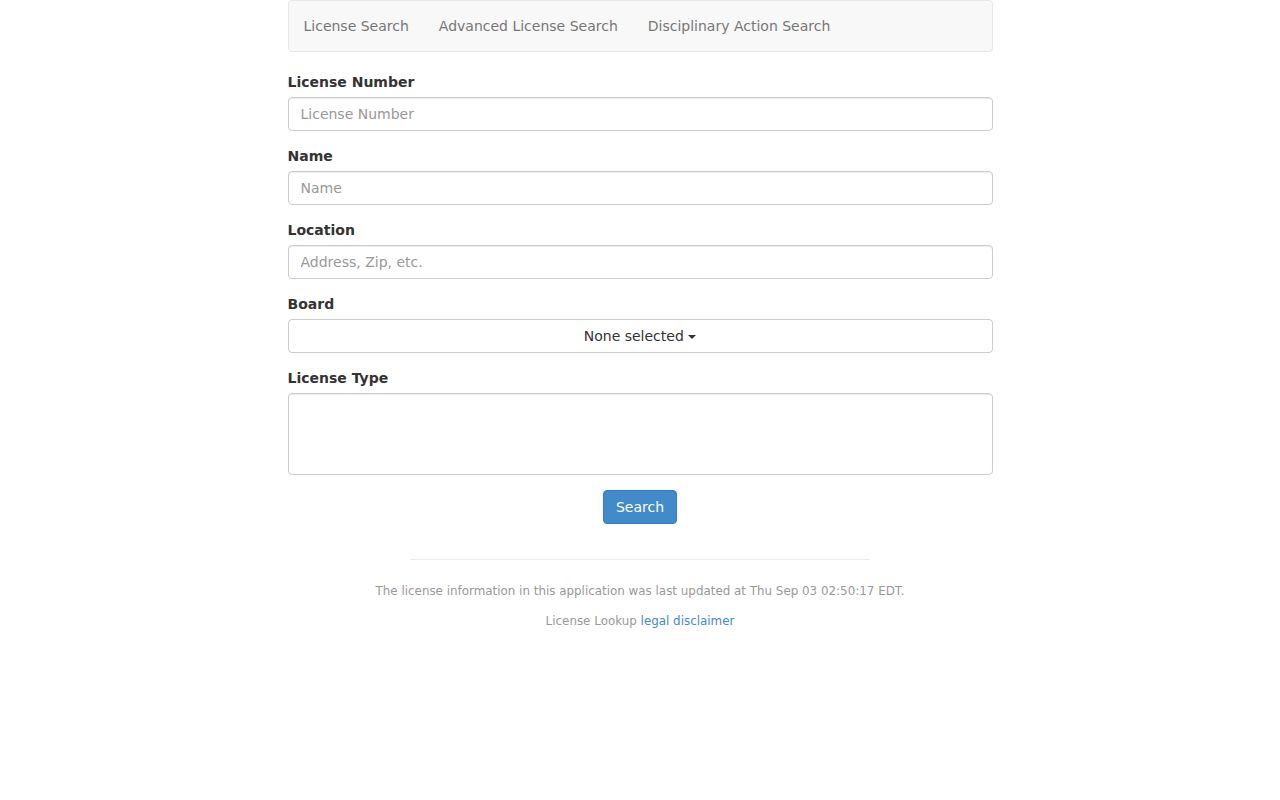
The form's board, type, location, and license controls earn their place. They separate a professional record from any claim about where a person actually lives.
Note: Label a match by its actual role, such as licensee, registered agent, owner, or speaker, rather than converting a business address into a residence claim.
Richmond Civic Record Leads
Richmond's public civic-group inventory supplies a useful neighborhood vocabulary. Church Hill, the Fan, Jackson Ward, Oregon Hill, Forest Hill, Blackwell, and Barton Heights are among the community areas. It can point to an organization or a stated area worth pursuing. The City cautions that the groups themselves supply the contacts, which may be inactive. No membership rolls are published. Pair the City civic-groups inventory with Council or Legistar items, library ephemera, newspapers, historic-district layers, and local oral-history collections. A public group contact or a speaker named in a meeting record is a dated civic connection. It is not an address confirmation. Treat it as one thread in a street directory search rather than proof of residence.
Richmond’s 1865 Record Gap
A missing Richmond deed or will is not proof that nothing happened. The evacuation fire of April 3, 1865 destroyed many wills and deed books. Boundaries complicate things too. Richmond's north-of-James division and its former Manchester division can make a record appear to sit in the wrong locality. Preserve the historical place name and division before concluding a search has failed. The Library of Virginia holds Richmond microfilm, chancery records, tax material, newspapers, directories, and later deeds. These can rebuild part of a broken trail. Chancery records shine when an estate or dispute names heirs, witnesses, plats, or relationships. Note the missing series, the date range, and the alternative sources consulted. That discipline keeps a residents directory conclusion no stronger than the surviving record supports.
Richmond Vital Record Paths
Birth, death, marriage, and divorce certificates live with the Virginia Department of Health. They are held by the Office of Vital Records, not with a City directory office. Access hinges on record type, age, eligibility, and current application instructions. Birth records open to the public after 100 years. Death, marriage, and divorce records open after 25 years, always subject to the custodian's rules. Eligible modern requests can go through Virginia's online, mail, walk-in, and application routes. A historical gap or a restricted record points elsewhere: Richmond Room collections, Library of Virginia microfilm, and FamilySearch marriage registers. Church and cemetery records, newspapers, probate, and directories also help. Adult adoptees born in Virginia gained a changed original-birth-record route under HB301 in 2026. Current identification and fee requirements still control that path. The Virginia Office of Vital Records keeps a Richmond walk-in office at 8701 Park Central Drive, Suite 100. It lists customer care at 804-662-6200. Its forms list a $15 certificate or search fee. A separate DMV route reports a different figure. Confirm the live form, the processing notice, the identification rule, and the payment route. Do this before sending anything. A historical index is a research lead for a ZIP code directory or genealogy project. It is not a certified record and not a current-identity finding.
Historical Richmond Resident Directories
Richmond's directory history runs deep. The Richmond Room keeps city and suburban directories from 1819 onward, plus yearbooks, phone books, newspapers, maps, and City Archives material. John Maddox compiled the first Richmond residents directory in 1819. Early listings often skip house numbers entirely. Instead, an entry might cite a landmark, a cross street, a ward, or a business. That habit fades as the century turns.
The 1879–80 street section was alphabetical by street, then numerical by address. This layout lets you trace a place through the residents directory even when the surnames shift from year to year. The Virginia Museum of History & Culture guide maps the major microfiche and shelf runs. For the full collection-reading method, see the Richmond city directory collections.
Compare consecutive directory years before trusting any conclusion. Then test the result against a deed, map, census, tax record, obituary, permit, or newspaper. A directory entry is dated evidence of an appearance in one printed source. It never proves continuous occupancy before or after that year.