
Finding Richmond Resident Records
Richmond is an independent city, not part of a Richmond County. That matters at the first click. A parcel inside City limits goes to the City Assessor, while a deed goes to the Richmond Circuit Court Clerk. A name in either record has a role and date. It may show an owner, grantor, heir, party, or dated directory entry. It does not automatically establish current occupancy.
Begin with the fact already known. An address is best checked through the parcel and map tools. A full name plus an approximate year often works better in the Richmond Room, city directories, newspapers, and archival indexes. A court number belongs with the court system. The public trail is a set of connected sources, not a single roster.
- For an address, find the parcel and confirm that it is in Richmond City rather than a nearby locality with a Richmond postal label.
- Keep the property address, parcel identifier, map result, and search date together before looking for a recorded instrument.
- For an older household, compare a dated directory entry with a census, deed, tax, newspaper, or cemetery source from the same period.
- For a court matter, confirm the locality, case number, event date, and disposition through the appropriate official route.
- When a portal lacks the needed item, ask the named custodian for a narrow record and date range, not a broad personal file.
Note: Record a source role, event date, and retrieval date so a deed party or historic directory listing is not treated as a current resident.
Richmond Resident Record Offices
Three City offices provide the most useful starting points. The Assessor connects a place to a parcel. The Circuit Clerk holds land, probate, and court-related records. The Office of Elections manages registration work, though its individual status tool is for a voter checking a record and its list products have strict statutory controls. Richmond has no county recorder or county assessor to substitute for these offices.
Richmond Circuit Court Clerk
John Marshall Courts Building
400 N 9th Street
Richmond, VA 23219
804-646-6505
Richmond Office of Elections
2134 W Laburnum Avenue
Richmond, VA 23227
804-646-5950
The Circuit Clerk’s record room is a fallback when remote access does not expose an image or older index. The Assessor and planning staff can clarify parcel and map routing. Elections staff can explain registration and authorized-list procedures. Phone calls help confirm a portal change, eligibility rule, or copy route before a trip or written request.
Richmond Parcel Search Fields
The legacy Richmond property search remains a useful guide to the kinds of details a parcel search can hold, even though the City reports that the system has been upgraded and the legacy route redirects toward a replacement. Search by address or parcel identifier first. The former owner-name option was removed in 2017 for safety, so an address or parcel is the practical City starting point.
| Field group | Richmond detail | Research use |
|---|---|---|
| Parcel ID | Partial text accepted in the legacy form, with autosuggest after eight digits | Stable key for map and deed research |
| Property address | Building number, optional range, direction, street name, and street type | Find a mapped property and normalize an address |
| Property ZIP | Legacy other-information filter | Narrow a search, never prove City jurisdiction |
| Assessment and transfer | Land, use, class, value, improvement, transfer, and year-built filters | Time-bound property context, not occupancy proof |
The legacy assessor search form shows the former address, parcel, transfer, improvement, and ZIP filters. It is a field inventory, not a promise that the replacement displays the same results.
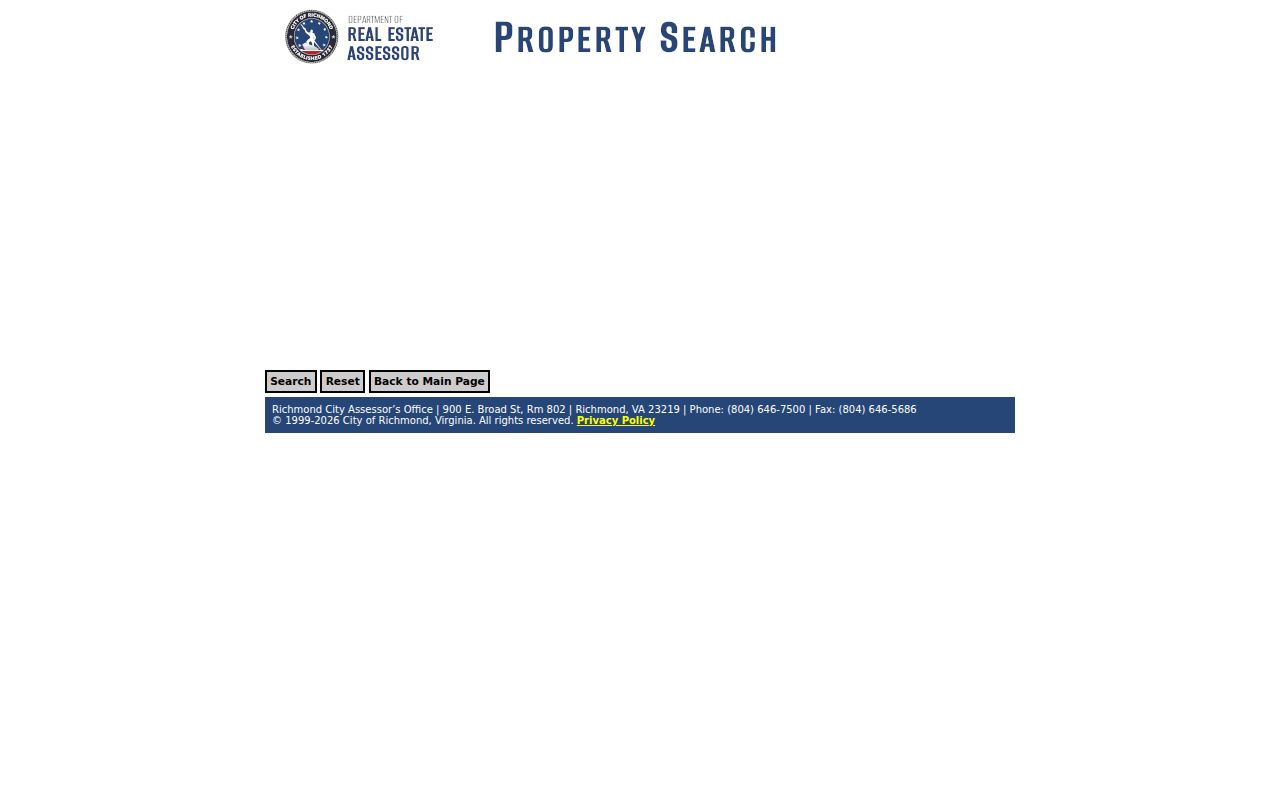
The capture preserves the address and parcel fields that remain useful when comparing a legacy result with the City’s current official routing.
Use the Richmond interactive mapping tools to search an address or intersection and click inside a parcel. A click on a right-of-way or outside a parcel can return no result. The mapper’s zoning, historic-district, and planning layers explain a place, but they are not a list of residents.
- Parcel
- A mapped property unit with an identifier used by assessment and land-record systems.
- Primary address
- The one assessment address the City maintains, which can differ from utility or emergency-address data.
- Grantor and grantee
- The party transferring an interest and the party receiving it in a recorded instrument.
- Record role
- The reason a name appears, such as owner, heir, witness, or party, rather than a claim of residence.
Richmond Voter Record Boundaries
Virginia’s Citizen Portal is a personal status route. It asks the voter for identifying information, locality, and a certification before returning registration-related information. It is not a public name search. The City election office also supports registration and election administration, but a voter result should not be republished as a resident list.
The Virginia voter-status screen is shown below as an official self-service route. Never enter a person’s sensitive values in a public worksheet or screenshot.
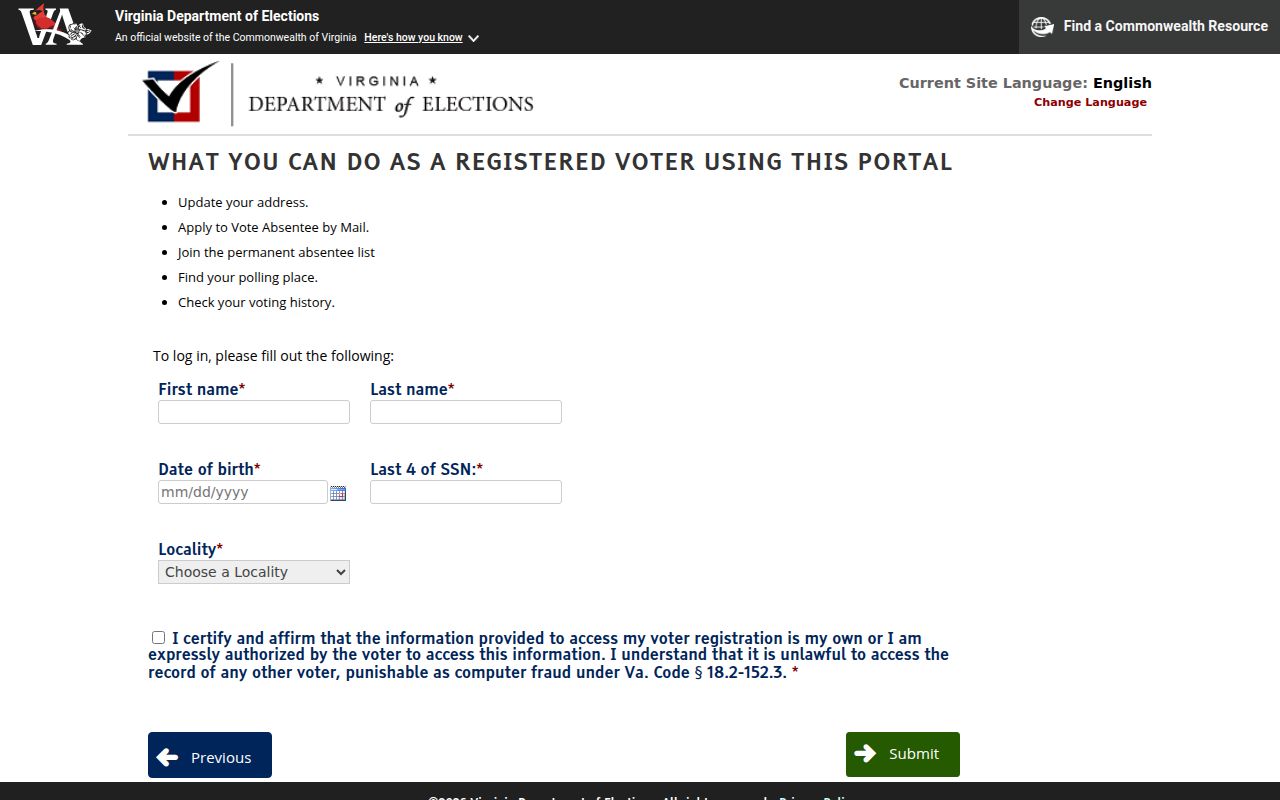
The form’s certification and identifying fields show why it should be used only for its stated self-check purpose.
Registered-voter and voting-history products are controlled by Va. Code §24.2-405 and related provisions. Authorized requesters must use the official process and stated purpose categories. The request form offers locality and district filters, but it is not an open feed for a searchable directory.
The official Virginia voter-list form documents the requester and product controls.
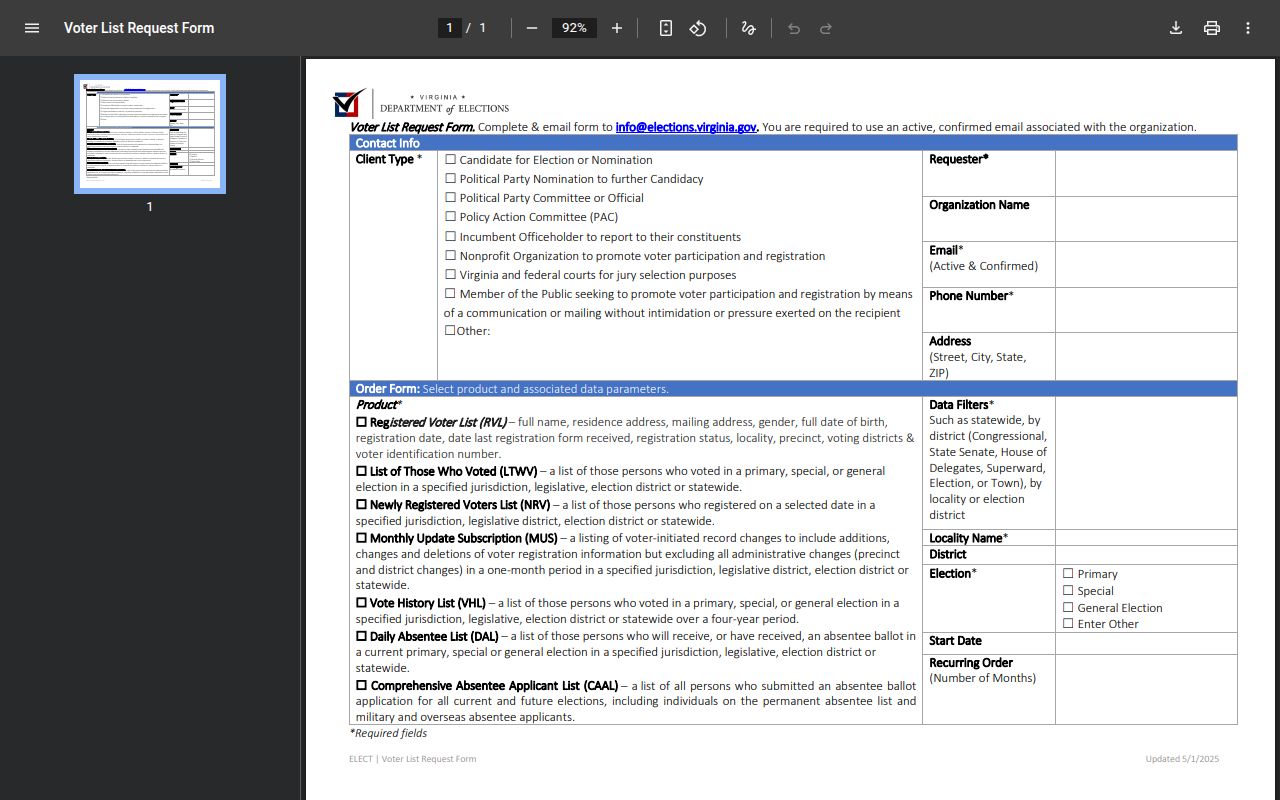
Its authorization and responsibility requirements are a reminder to use voter material only through the statutory route.
Richmond Deed and Court Trails
The Richmond Circuit Court Clerk is the land-record custodian for deeds, deeds of trust, plats, wills, estates, marriage licenses, and recorded instruments. Land records are digitized back to 1782. Division I covers the area north of the James, while Division II covers the south side, including old Manchester, back to 1874. A deed is evidence of a property transaction, not proof that every named party lived at the address.
Deed Search and the Clerk’s secure remote-access route describe the online path. Subscriber access, in-person research, and written requests are separate channels. A written request should identify the instrument, parties, date range, book and page or instrument number, and whether a certified copy is needed. Research materials list copies at $0.50 per page, plus $2 for certification, with payment due in advance.
The statewide Online Case Information System has Name, Case Number, and Hearing Date modes. It returns selected court and case data, then a local clerk supplies the complete file when permitted. OCIS does not include every record category and hides protected material in some J&DR matters.
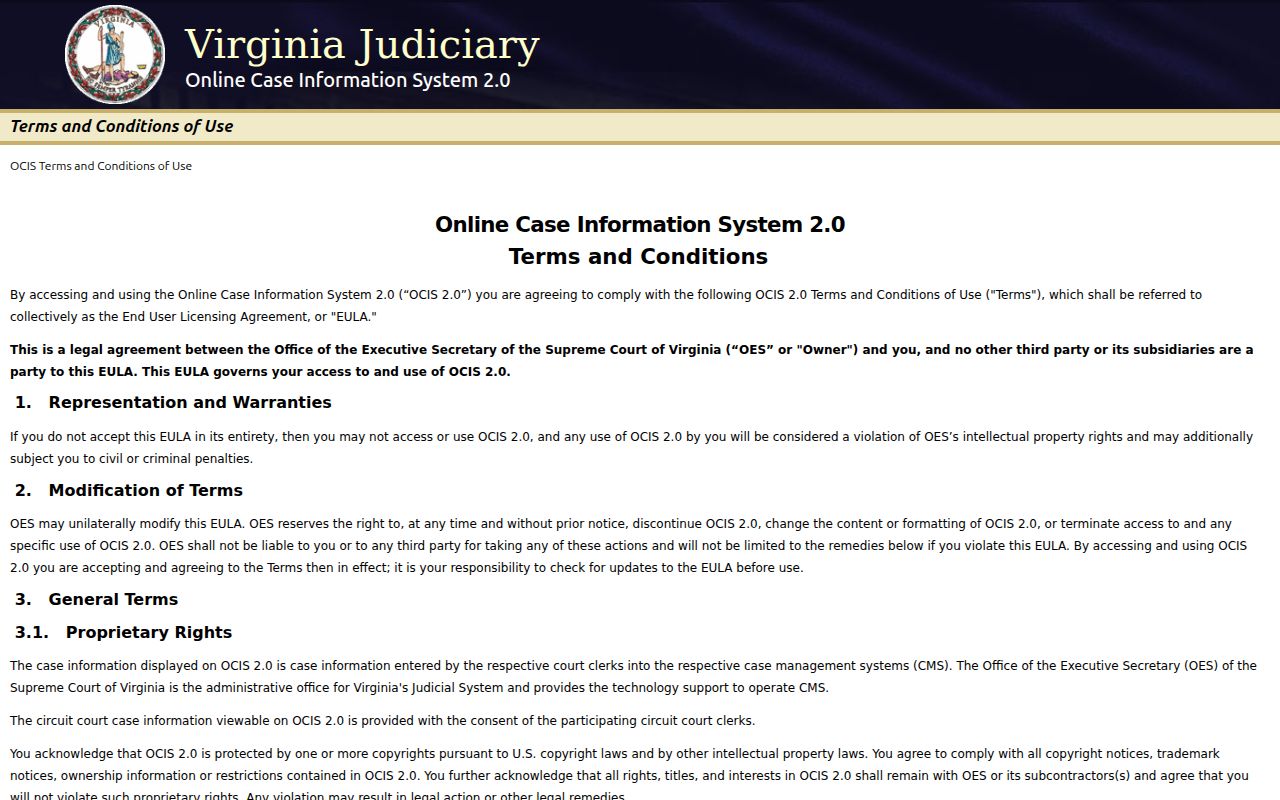
The acknowledgement screen signals that an official case search has scope and use limits before any search fields are used.
Richmond FOIA Record Requests
When a City record is not available through its normal portal, Virginia’s Freedom of Information Act provides a request route. Under Va. Code §2.2-3704, a public body generally responds within five working days by producing records, citing a withholding basis, explaining that it does not hold the records, or stating that more time is needed. Ask for a defined record, date range, and electronic delivery where available.
The City’s FOIA page lists online, mail, fax, email, in-person, and phone routes. Richmond announced a new request platform in May 2026, while Richmond Police maintains its own FOIA channel. The portal does not replace a department’s specialized process, and exemptions or redactions can still apply.
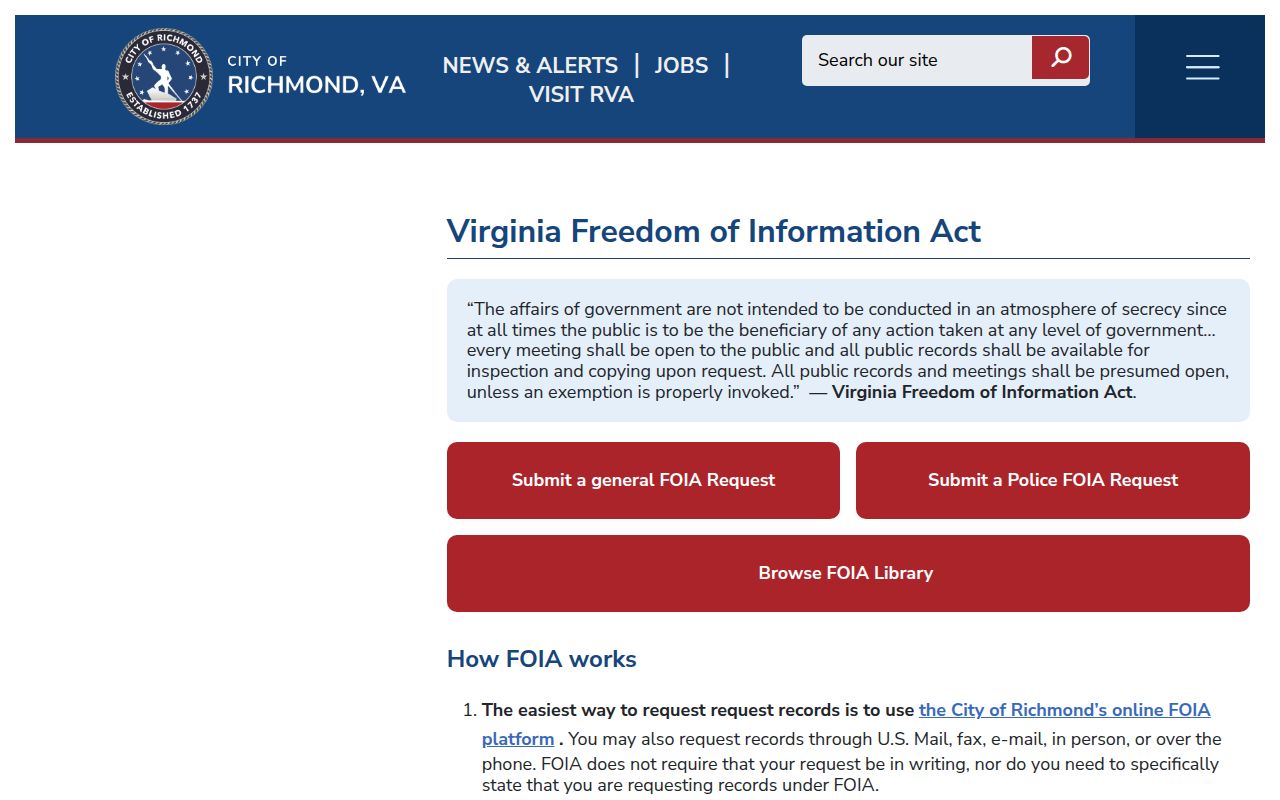
The City entry point is useful for tracking a narrow City request after the correct custodian has been identified.
The Richmond Police FOIA form illustrates why the request should state the report or incident and date range. Its fee and deposit notices should be confirmed on the current form before payment.
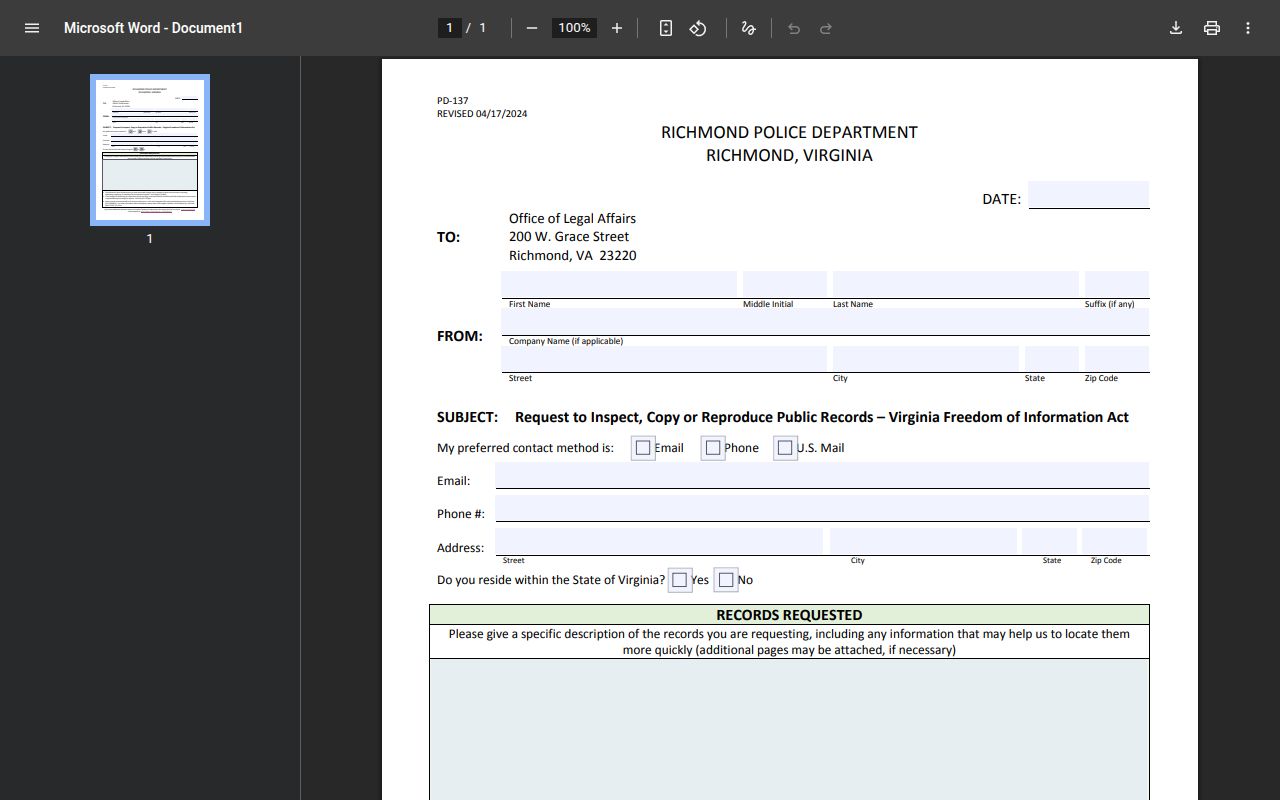
Specific fields on the form help a requester describe a record without turning a public request into a broad personal-file search.
Current Richmond Directory Sources
Current sources answer narrow questions. The parcel tools identify property context. Court and deed indexes identify a filing or instrument. Permit, code, Council, cemetery, and civic records can tie a person or organization to a dated event. None operates as an all-purpose list of City residents, and each needs a source-specific interpretation.
| Source | What it can show | Custodian | Access boundary |
|---|---|---|---|
| Parcel and map record | Parcel, address, assessment context, map relationship | Richmond Assessor and Parcel Mapper | Public route; property evidence is not occupancy proof |
| Land index | Recorded parties, instrument, date, legal description | Richmond Circuit Court Clerk | Remote, counter, and written channels vary |
| Permit or code record | Project, address, status, dates, possible responsible party | Richmond PDR | Underlying files may require a request |
| Civic group inventory | Organization name, stated area, supplied contact | City of Richmond | Orientation only, no published member roll |
For one carefully bounded name-and-date question, the Richmond resident lookup route explains how to anchor a result to independent records instead of relying on a single plausible match.
Richmond License Record Checks
Business and license records can explain why a person’s name appears in Richmond. They should be read as organization or credential records, not as household listings. Virginia SCC CIS uses an entity name or ID for business filings. The Department of Professional and Occupational Regulation can search regulated license records by name, license number, address or ZIP, board, and license type.
The DPOR advanced search is an official way to check a credential’s stated status and related details. Online data are not the complete public record, and the Department’s public-records route remains available for fuller file questions.
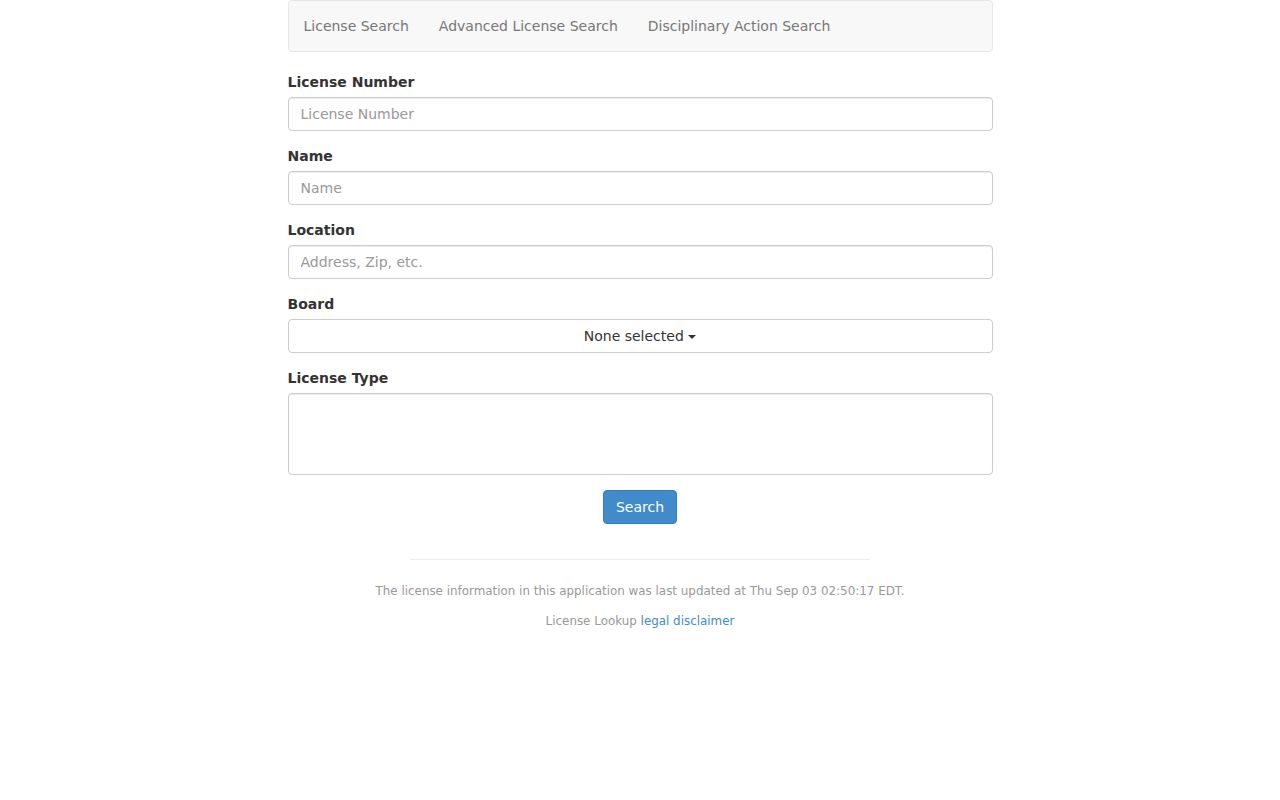
The form’s board, type, location, and license controls help distinguish a professional record from a claim about a person’s residence.
Note: Label a match by its actual role, such as licensee, registered agent, owner, or speaker, rather than converting a business address into a residence claim.
Richmond Civic Record Leads
Richmond’s public civic-group inventory gives a useful neighborhood vocabulary, including Church Hill, the Fan, Jackson Ward, Oregon Hill, Forest Hill, Blackwell, Barton Heights, and other community areas. It can identify an organization or stated area for further research. The City warns that contacts are supplied by the groups and may be inactive, and it does not publish membership rolls.
Use the City civic-groups inventory with Council or Legistar items, library ephemera, newspapers, historic-district layers, and local oral-history collections. A public group contact or a speaker in a meeting record is a dated civic connection. It is not an address confirmation.
Richmond’s 1865 Record Gap
A missing Richmond deed or will is not always evidence that no transaction happened. The April 3, 1865 evacuation fire destroyed many wills and deed books. Richmond’s north-of-James and former Manchester divisions can also make a record appear to be in the wrong locality. Preserve the historical place name and division before deciding that a search has failed.
The Library of Virginia’s Richmond microfilm, chancery records, tax material, newspapers, directories, and later deeds can rebuild part of a broken trail. Chancery records are especially useful when an estate or dispute names heirs, witnesses, plats, or relationships. Record the missing series, date range, and alternative sources checked rather than making a stronger conclusion than the surviving record supports.
Richmond Vital Record Paths
Birth, death, marriage, and divorce certificates are held by the Virginia Department of Health Office of Vital Records, not a City directory office. Access depends on the type, age, eligibility, and current application instructions. Birth records become public after 100 years; death, marriage, and divorce records become public after 25 years, subject to the custodian’s rules.
For eligible modern requests, Virginia provides online, mail, walk-in, and application routes. For a historical gap or a restricted record, Richmond Room collections, Library of Virginia microfilm, FamilySearch marriage registers, church and cemetery records, newspapers, probate, and directories may be better leads. Adult adoptees born in Virginia gained a changed original-birth-record route under HB301 in 2026, with current identification and fee requirements still controlling.
The Virginia Office of Vital Records has a Richmond walk-in office at 8701 Park Central Drive, Suite 100, and lists customer care at 804-662-6200. Researched July 2026 forms list a $15 certificate or search fee, while a separate DMV route reports a different figure. Confirm the live form, processing notice, identification rule, and payment route before sending a Richmond request. A historical index is a research lead, not a certified record or a current-identity finding.
Historical Richmond Resident Directories
Richmond’s long directory run is the most practical historical household trail. The Richmond Room holds city and suburban directories from 1819 to the present, along with yearbooks, phone books, newspapers, maps, and City Archives material. The first Richmond directory was compiled by John Maddox in 1819. Early entries may use a landmark, cross-street, ward, or business instead of a house number.
By 1879–80, the directory street section was alphabetical by street and numerical by address. That lets a researcher follow a place even when surnames change. The Virginia Museum of History & Culture guide documents the major microfiche and shelf runs, while the full collection-reading method belongs in the Richmond city directory collections.
Compare consecutive years, then test the result against a deed, map, census, tax record, obituary, permit, or newspaper. A directory entry is dated evidence of an appearance in that source. It is not proof of continuous occupancy before or after the printed year.