
Richmond Previous Residents Sources
The best order depends on the era. For a recent address, begin with the City Assessor or Parcel Mapper to retain the parcel identifier, primary address, and map position. Then use the Richmond Circuit Court Clerk's land-record route for the recorded chain. For an earlier household, add the street section of a city directory, a census schedule, and the Richmond Room's newspaper or obituary resources. A deed shows a recorded party and property description, not who occupied the building. A directory is dated evidence of a listing, not proof of a present resident.
| Source | Years It Covers | Where Held | What It Shows |
|---|---|---|---|
| Richmond Circuit land records | Digitized to 1782 | Circuit Court Clerk | Recorded parties, instrument, legal description, book or instrument reference |
| Richmond city directories | 1819 to present; nearly annual from 1870 | Richmond Room and VMHC guide | Dated address and household or business listing |
| Federal census schedules | Named households, 1850-1950 | National Archives and library databases | Household members and period details |
| LVA Chancery causes | Richmond images, 1783-1879 | Library of Virginia | Heirs, testimony, wills, plats, and disputes |
| Richmond Sanborn map sets | 1886, 1895, 1905, 1908, 1919, 1924-25, 1952 | Library of Congress | Building footprint, use, materials, and surrounding context |
Use the date on every row as part of the finding. Richmond is an independent city, so the city clerk and city archives are often the right custodians instead of a county office. Historic Manchester also needs its own note: land records south of the James are organized through Division II, and historic locality names can differ from a modern Richmond label.
Richmond Address Starting Points
The Richmond Assessor is useful for a current parcel identifier, assessment context, primary property address, and map relationship. The legacy public search remains valuable as a field inventory, but it now redirects toward a replacement system. During research, the replacement returned an access error. Do not assume that the old search fields, exports, or result screens remain available. The legacy owner-name search was removed in 2017 for safety concerns.
For a spatial check, use the City's Interactive Mapping Tools. Parcel Mapper accepts an address or intersection query, then opens an information box when a parcel is clicked. A point in a right-of-way or outside a parcel may return no result. Keep the original street string, the map result, and the parcel ID together. A primary assessment address can differ from utility or emergency addresses, and a parcel split may not appear in the assessment system until the following year.
- Parcel identifier
- A map or assessment key for a tract. It is more stable than a street spelling, but it may change after a split, merger, or subdivision.
- Primary address
- The assessment address maintained for the property. It is not a complete list of every address associated with a building.
- Legal description
- The recorded parcel wording, lot reference, or map reference that ties a deed to land when a street address changes.
Richmond Previous Residents Deed Trail
The Richmond Circuit Court Clerk deed-search route and its Secure Remote Access service cover deeds, deeds of trust, plats, wills and estates, and other instruments. Land records are digitized back to 1782. Division I covers north of the James from 1782, while Division II covers south of the James, including old Manchester, from 1874. Older searchable ranges and current subscription terms can change, so read the clerk's coverage notice at the time of the search.
Current indexing reaches roughly deeds from 1993 and wills from 1995 or 1996. Earlier searchable ranges extend to about 1965 or 1966 for Division I and 1936 or 1937 for Division II, with historical index books for earlier material. Secure remote access is for approved subscribers. The clerk also provides in-person access and accepts written copy requests. Written requests should give the instrument type, parties, date range, book and page or instrument number, and whether a certified copy is needed.
- Record the current parcel identifier, legal description, and exact address wording from the City source.
- Find the recorded purchase instrument for the known owner or property reference through the clerk's available index.
- Copy the grantor, grantee, instrument type, recording date, division, and book-page or instrument number.
- Search the earlier seller as a grantee to locate the prior acquisition, then repeat the dated sequence.
- When the online range ends, use the historical index books, in-person record room, or a written request rather than guessing across the gap.
Copies are listed at 50 cents per page, with an additional $2 for a certified copy, and payment is due in advance. The clerk is in the John Marshall Courts Building, 400 N. 9th Street; general phone is 804-646-6505 and the record room is 804-646-6530. Note: Recorded ownership and occupancy are separate facts.
Richmond Previous Residents in Chancery
When the title trail reaches an estate, dispute, or family transfer, the Library of Virginia Chancery Records Index can provide a different kind of evidence. Richmond City images for 1783-1879 were expanded in 2025. A cause can include bills, answers, depositions, wills, plats, heir lists, witness names, and relationship evidence. That makes Chancery especially useful for linking a property clue to widows, children, heirs, or a prior legal description.
The index alone does not tell the whole story. Open the scanned file where available and preserve the case number, locality, parties, date, and document type. Some files may be closed during processing, conservation, or digitization. A relationship named in a Chancery document is tied to that case and date; it should not be broadened into an unsupported present-day claim.
The LVA Chancery collection is the source for the image and access information.
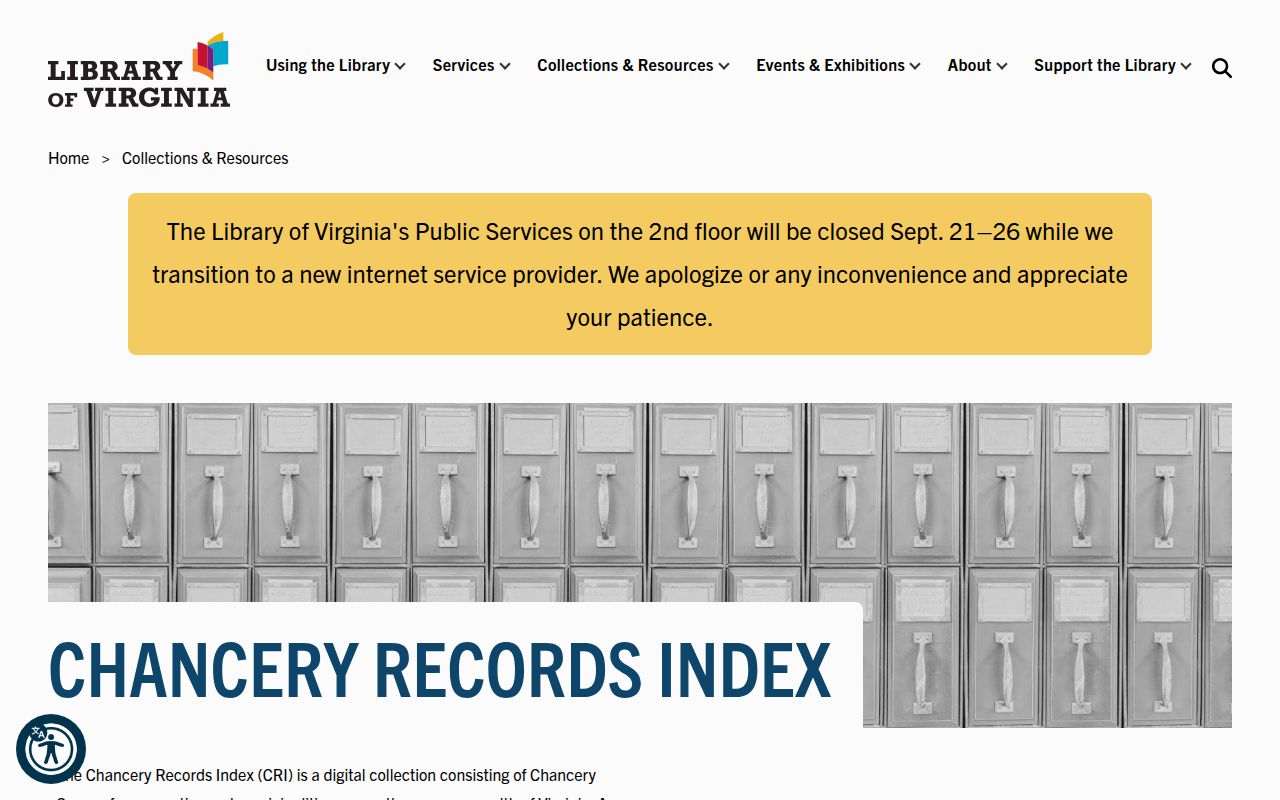
The index is a useful transition from a deed reference to a file that may contain plats, family relationships, or an estate record.
The sample Richmond Chancery cause detail shows the kind of indexed file metadata that should be copied into an address-history log.
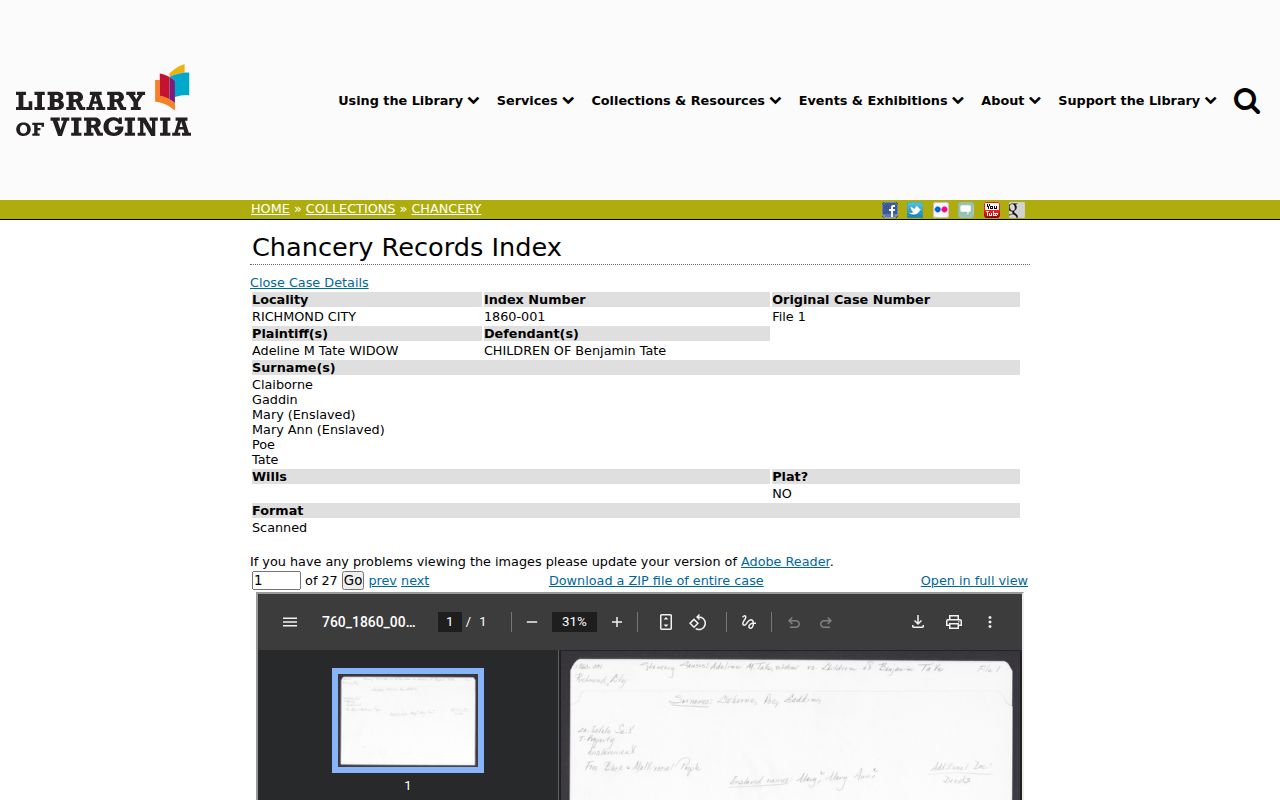
A case number, locality, party names, file number, and scanned-file reference make a Chancery clue easier to revisit without extending the record beyond what it states.
Richmond Previous Residents Map Evidence
Sanborn fire-insurance maps help test continuity of the place behind an address. Richmond's series includes an 1886 set with 35 sheets and Manchester, plus a 1895 set, linked 1905 sheets, a 1908 supplement, 1919 South Richmond, 1924-25 volume 2, and a 1952 republication. A sheet can show a building footprint, materials, use, nearby structures, and street context. It does not provide a complete list of occupants.
Open the Library of Congress Richmond Sanborn collection after recording the historic street name and cross streets from a directory or deed. Compare the sheet date with the directory year. A building appearing in one source and not the prior year can identify a construction window, but it is still a lead to verify with permits, tax material, or an assessor record.
Map evidence works particularly well where a street name, ward, or parcel shape has changed. It also prevents a modern parcel map from being treated as a direct picture of an older lot.
Richmond Previous Residents Household Trail
Owners are only part of the address history. The Richmond Room holds city and suburban directories from 1819 to the present, while the VMHC guide identifies directory runs and explains that the street-address section became alphabetical by street and numerical by address in 1879-80. That makes the street section the appropriate source for a dated address question. The collections themselves are described in the Richmond Directory Book.
Pair an entry with the nearest census year. Federal schedules from 1850 through 1950 can show named household members, ages, birthplaces, and other period fields. The 1890 census loss is a real hole in that sequence. For a disappearance or change, compare adjacent directory editions, a newspaper or obituary, cemetery records, tax material, and the next available census before choosing an explanation.
- Write the directory year, original address, printed name, page, and any ward or business indicator.
- Check nearby directory years for spelling shifts and for a new entry at the same location.
- Match the dated address to the nearest available census household and retain both source dates.
- Use an obituary, cemetery entry, newspaper notice, deed, or Chancery file to test the end of a household trail.
Richmond Previous Residents Gaps
The April 3, 1865 evacuation fire destroyed many Richmond wills and deed books. The loss is not uniform. Surviving deeds, tax records, directories, newspapers, church and cemetery material, later abstracts, and Chancery files can still reconstruct part of a person or property trail. A missing book does not prove that no transaction occurred. Put the gap in the research log, name the missing series, and move to a separate source that overlaps the date.
Early directory entries also used descriptive landmarks and cross streets because modern house numbers were absent. Later annexations, renamed streets, ward changes, and parcel subdivisions can create a false discontinuity when a historic address is copied into a current field. Keep original wording, a map comparison, the division searched, and the uncertainty note together.
Richmond Previous Residents Record Log
A short worksheet keeps the trail readable: current and historic address forms, parcel ID, deed division, grantor and grantee, instrument date, book-page or instrument number, directory edition and page, census year, map sheet, repository URL, and retrieval date. For a record that does not fit, record why. It may be a change in street name, an unindexed range, a lost book, a former Manchester location, or an address that identifies a business rather than a home.
Use only the narrow fact each record supports. That practice helps separate a recorded owner from an occupant, a directory listing from a map clue, and a family link from a proven address. Note: Richmond's historical records are strongest when several dated sources agree, and most useful when their differences are preserved.