
Richmond City Directory Shelf
Richmond's main historical shelf is unusually broad. The Richmond Public Library Local History & Genealogy collection keeps city and suburban directories from 1819 to the present, along with phone books, newspapers, yearbooks, maps, and City Archives material. The Richmond Room is on the first floor of the Main Library at 101 E. Franklin Street. Its local collection does not circulate, so plan to consult it there. Visitors may browse while the Main Library is open; appointments are encouraged for fragile, restricted, or specific items.
| Collection | Years | Where Held | Access |
|---|---|---|---|
| Richmond Room directories | 1819 to present | Richmond Public Library | Noncirculating, on-site research |
| VMHC Mss 14 no. 8 | 1819, 1845, 1845/46, 1850/51, 1852, 1855-56, 1858-60 | Virginia Museum of History & Culture | Microfiche collection |
| VMHC Mss 10 no. 267 | 1882/83-1901 | Virginia Museum of History & Culture | Collection access through the property guide |
| VMHC Mss 10 no. 268 and F234.5 R5 | 1902/03-1935; 1936-current | Virginia Museum of History & Culture | Collection access through the property guide |
The VMHC Richmond property guide reports nearly annual publication from 1870 and identifies the specific runs above. It is the best bridge between a current street address and a sequence of older entries. Gaps still matter. The early run has an 1845 gap, and any absent year should be recorded as an unavailable or unlocated source, not treated as evidence that a household was absent.
Richmond Room Directory Research
The Richmond Room gives a city directory search useful companions that an online index may not show. Its holdings include the Richmond Times-Dispatch, News Leader, Richmond Afro-American, Richmond Planet, local school and university yearbooks, area phone books, and more than 1,500 ephemera files. City Archives maps, reports, and ordinances can help explain a changed street or ward. Scanning, photography, and in-library copies are encouraged when condition and rights allow.
Call the Richmond Room at 804-646-0117 before a long visit, especially when a volume, newspaper issue, or archive item is central to the search. The library also lists in-library Ancestry access, Main Library-only LexisNexis and Westlaw, NewsBank, and Heritage Hub obituaries. Those services can help corroborate a dated directory entry. They should not turn an old printed listing into a claim about current residence.
A Richmond Room collection view shows the local-history setting behind these materials.

The collection page helps a visitor identify the Richmond Room before checking a particular directory year or related newspaper source.
Richmond Directory Before Numbers
Richmond's first directory was The Richmond Directory, Register, and Almanac, for the Year 1819, compiled by John Maddox. The Library of Virginia's Maddox profile explains a key limitation of that first volume: house numbers were not then in use. An entry may therefore identify a person by street, cross-street, ward, business, or a nearby landmark. Preserve that wording exactly before attempting to match it to a modern map.
This is more than a formatting oddity. A landmark-based location can lead to the right historic map, while forcing it into a present-day number can create a false match. Richmond's later annexations, renamed streets, ward changes, and parcel divisions add more reason to retain the original entry beside a normalized address.
The Maddox directory is documented on the Library of Virginia collection page.
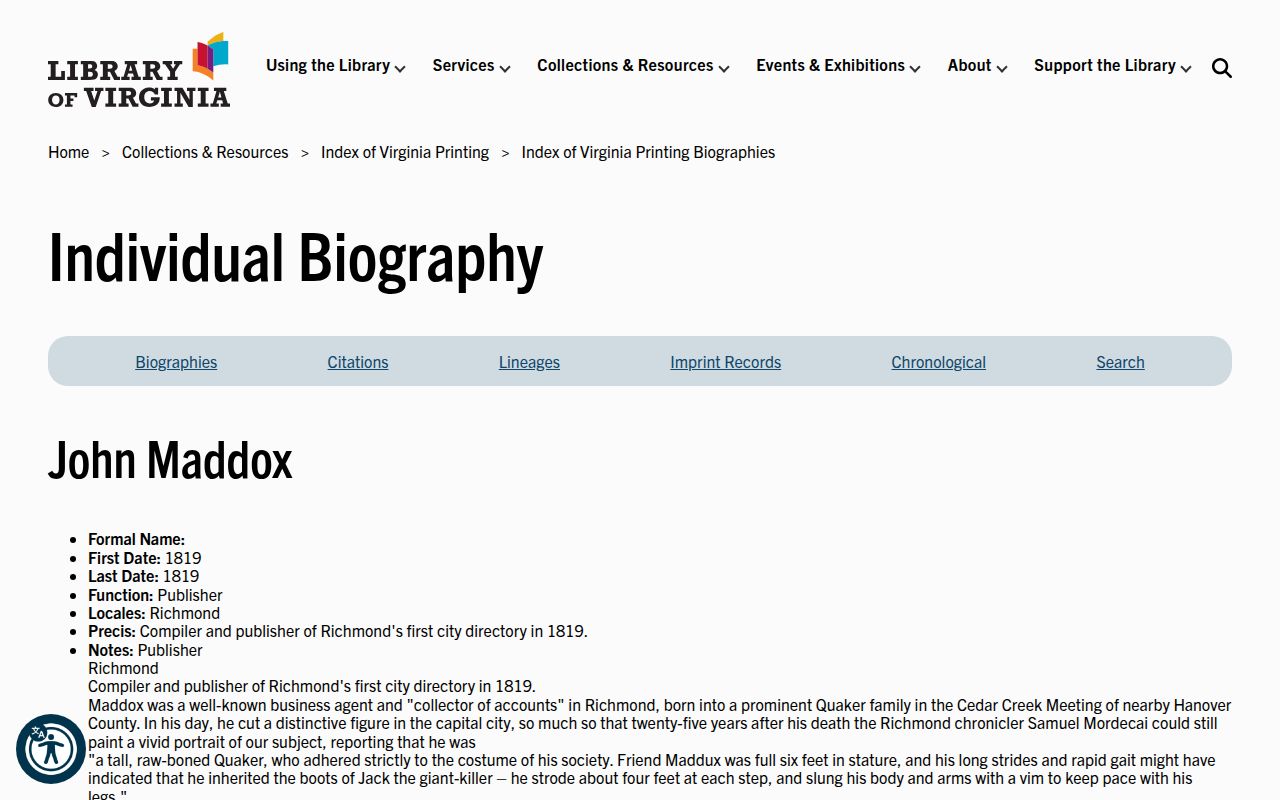
That source gives useful context for descriptive early locations that do not resemble a present street-address format.
Reading Richmond City Directory Entries
A city directory entry has to be read as a dated publication record. It may give a name, a residence or business location, and a role or occupation. An entry can reflect a business contact rather than a household, and a name can appear differently in consecutive years. Photograph the volume's abbreviation key and title page with the entry. They identify the edition and explain the conventions used by that publisher.
| Name | Copy the printed spelling and initials, then note any variant separately. |
|---|---|
| Address or location | Keep the street wording, number, cross-street, ward, or landmark exactly as printed. |
| Role | Distinguish a residence, business, organization, or other printed association. |
| Edition detail | Record the year, publisher or compiler, page, repository, and scan or shelf reference. |
| Nearby entries | Note adjoining names in a street section only as dated context, not as a present-neighbor list. |
- Criss-cross directory
- A reverse or street-order section that starts with an address rather than a surname. Richmond's street-address sections became systematic in 1879-80.
- Householder index
- An index arranged around the person or household named by the volume, rather than by a modern database identifier.
- Abbreviation key
- The publisher's guide to shortened terms and marks. Read it before expanding a label into a fact the volume does not state.
Richmond City Directory Street Sections
Beginning with 1879-80, Richmond directory street sections were arranged alphabetically by street and numerically by address. That change makes a city directory especially useful for a house-history question. Start with the exact printed street form in one year, read the address entry, then check the years immediately before and after it. A name change at the same address is a lead to corroborate, not final proof of a move or ownership change.
For south-of-James research, keep historic Manchester wording in the notes. The city and the former municipality can surface under different place labels, while present parcel geometry may not duplicate a historical lot. For current address-keyed sources, use the Richmond Street Directory after the historical forms have been preserved.
Richmond City Directory Timeline
A time line prevents a directory search from skipping over the changes that affect an address. The available chronology begins with Maddox's 1819 book, includes the separate early microfiche volumes named by VMHC, and becomes far denser after 1870. The series belongs beside a record's date, not outside it. For example, a street-form match in a late nineteenth-century entry is much more useful than one imposed on the descriptive wording of an 1819 entry.
- 1819: John Maddox compiled Richmond's first known directory, using descriptive locations because house numbers were not in use.
- 1845 to 1860: The VMHC Mss 14 no. 8 microfiche run preserves selected early editions, including 1845, 1845/46, 1850/51, 1852, 1855-56, and 1858-60.
- From 1870: The VMHC guide reports that Richmond directories were published nearly every year, giving a closer year-by-year trail.
- 1879-80: The street-address section became alphabetical by street and numerical by address, allowing direct comparison of a location through later editions.
- 1936 to current: VMHC identifies its general F234.5 R5 directory run, while the Richmond Room continues to hold city and suburban directories.
The April 1865 fire, street changes, ward shifts, and later annexations explain why that chronology can contain gaps or conflicting location forms. Keep the edition date with every citation. The Library of Virginia Richmond microfilm guide is an additional route for city administrative and court material that can test a directory lead.
Trace Richmond City Directory Households
Use a city directory to make a dated chain, not a one-year snapshot. Start with the first known edition, write down the entry as printed, and work forward or backward through adjacent editions. Pair the decade with the federal census when available. NARA's census holdings run from 1790 through 1950 under the 72-year release rule; the named household schedules begin in 1850. The 1890 census loss leaves an important gap, so a directory and newspaper may be the closer sources for that interval.
- Locate the first plausible Richmond city directory entry and record its year, page, wording, and repository.
- Check the surrounding editions for address changes, spelling shifts, and business-versus-residence distinctions.
- Use the street-order section from 1879-80 forward to compare the same address in the same year.
- Pair a dated directory clue with the nearest available federal census household, then note conflicts rather than forcing a match.
- Use an obituary, newspaper, cemetery source, deed, or tax record to test an endpoint in the trail.
People can disappear from a directory because they moved, died, changed a business address, were omitted, or were listed under a different spelling. A census, newspaper, tax list, or deed can narrow that choice. The National Archives census overview explains the release schedule and scope of those federal records.
Richmond Directory Companion Sources
Directories work best beside records that answer a different question. The Library of Virginia Chancery Records Index includes Richmond City images added for 1783-1879 in 2025. A Chancery cause may contain bills, answers, depositions, wills, plats, heir lists, witness names, and relationships. It can connect a name in a directory to a property or family record, but some material remains closed while it is processed, conserved, or digitized.
VCU Libraries' digital collections add oral histories, architecture and survey material, yearbooks, and news collections. Sanborn maps add building footprint, materials, use, and adjacent-structure context. These sources do not create a complete resident list. They help test whether a street, structure, organization, or household association makes sense for the date of the directory entry.
The VMHC property-research guide brings directory runs, deeds, taxes, maps, permits, and photographs into one address-history workflow.
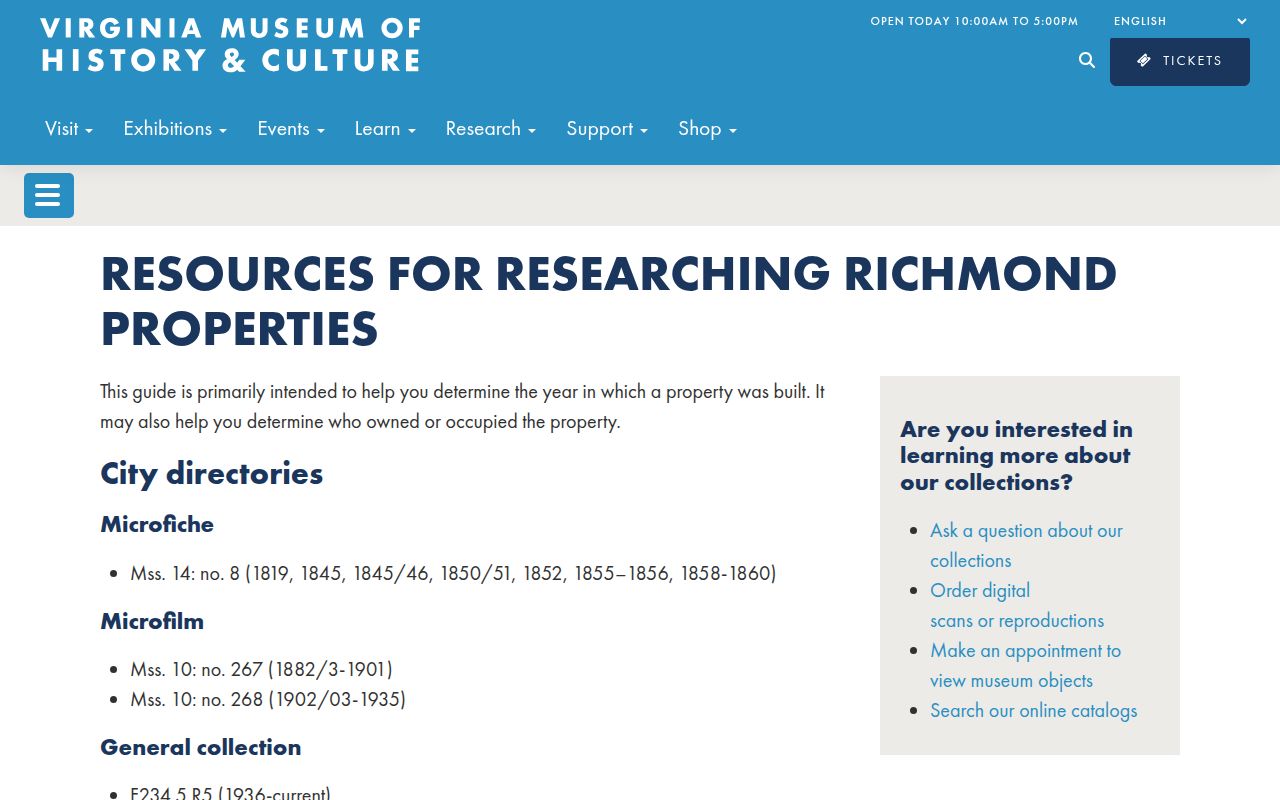
The guide is a practical way to move from a city directory entry to a separate record type without treating the entry as a complete answer.
Richmond City Directory Gaps
Richmond records have gaps that deserve plain labels. The April 3, 1865 evacuation fire destroyed many wills and deed books, though the loss was not uniform. Surviving deeds, Chancery files, tax records, newspapers, directories, church and cemetery material, and later abstracts can still support a careful reconstruction. A missing deed book or unlocated directory should never be described as proof that no transaction or household existed.
Keep a small research log with the edition, page, original address wording, repository, URL or shelf reference, date checked, and the next source to test. That preserves uncertainty and makes a return trip to the Richmond Room or an archive much more efficient. Note: A historical city directory is evidence for its publication year, not a current occupancy record.